
Explore practical approaches to sustainability, climate adaptation and green safe spaces.
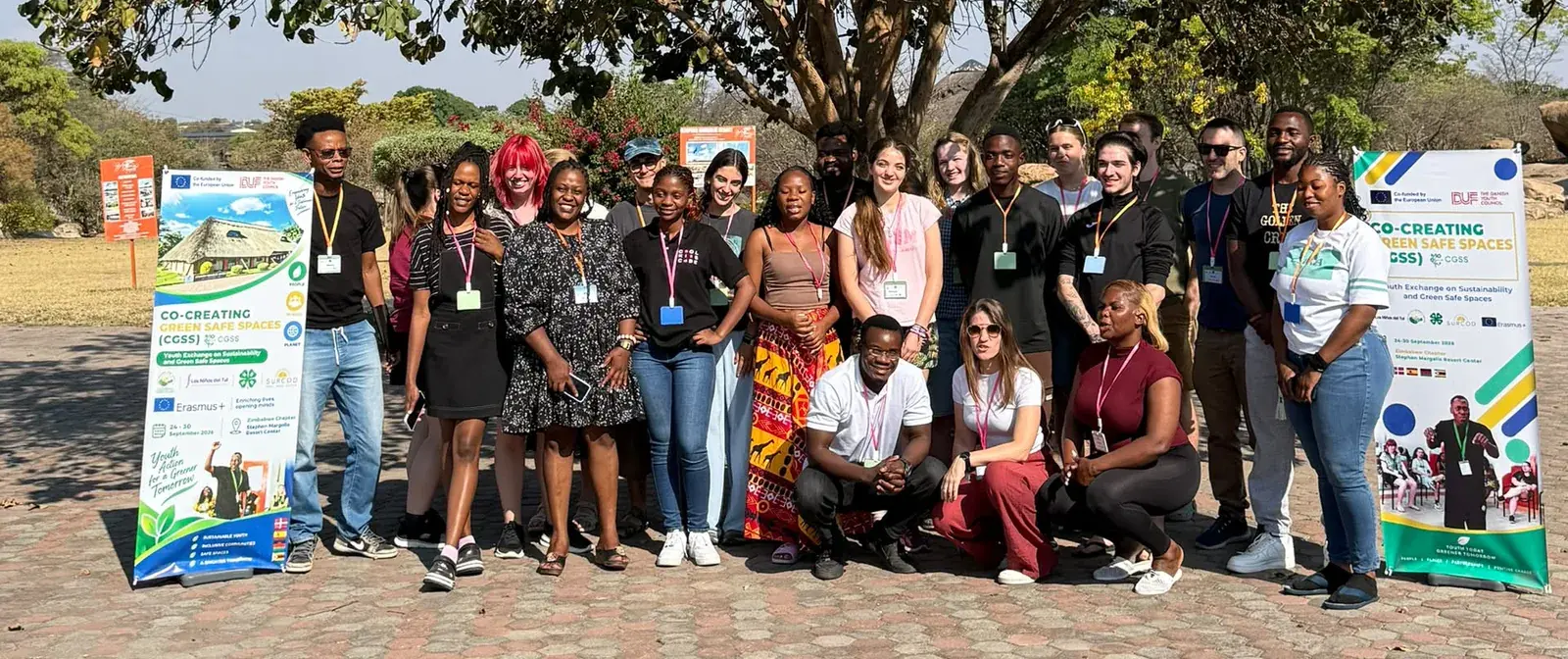
Project 09CompletedYouth Exchange
Green Safe Spaces: Zimbabwe Youth Exchange
Young people connecting climate action, inclusion and community leadership.
Seven SURCOD delegates joined partners in Zimbabwe for a week of practical learning, youth dialogue and intercultural exchange. Together, they explored how green safe spaces can support sustainable food growing, inclusion and meaningful youth participation.
- Location
- Stephen Margolis Resort Center, Zimbabwe; visits in Harare and Domboshava
- Dates
- 24–30 September 2026
- Countries
- Malawi · Zimbabwe · Denmark · Spain
- Malawi delegation
- 7 SURCOD delegates from Malawi
Project overview
Learning together for greener, more inclusive communities.
From 24 to 30 September 2026, the Co-Creating Green Safe Spaces partnership brought young people and youth organisations together in Zimbabwe. Hosted by the Rural Enterprise Trust of Zimbabwe (RETZ), the exchange connected partners from Malawi, Zimbabwe, Denmark and Spain through shared learning and practical activities.
The programme combined workshops at Stephen Margolis Resort Center with visits to Zimbabwe’s Parliament, GMRI Organic Farm and a RETZ community garden in Domboshava. Participants explored how welcoming green spaces can bring together food growing, dialogue, peer support and shared responsibility.
For the seven SURCOD delegates, the exchange was an opportunity to contribute experiences from Malawi, learn from other communities and develop ideas for youth leadership and the Chikwa Eco Village Garden.
Read the Zimbabwe exchange report ↗Related SURCOD programme
Youth & Digital Innovation →Objectives
Climate action shaped by young people.
Strengthen young people’s influence in decisions that affect their communities.
Build skills in inclusive facilitation, teamwork and non-formal education.
Connect community gardening with social inclusion, learning and shared responsibility.
Exchange cultural knowledge and strengthen cooperation across the partner countries.
Develop ideas and commitments that participants can take into local youth initiatives.
Methodology
Learning through visits, dialogue and practice.
Participants learned through experience: visiting community initiatives, working in small groups, modelling garden ideas, debating youth priorities and reflecting together. Facilitation encouraged everyone to contribute knowledge from their own context. Cultural activities and informal conversations helped build the relationships needed for shared learning.
Activities
- Shared-values, safeguarding and inclusion exercises to create a welcoming learning environment.
- A visit to Zimbabwe’s National Assembly and Senate, followed by a mock parliamentary debate on green safe spaces and climate change.
- Learning at GMRI Organic Farm about soil-moisture monitoring, targeted irrigation and digital tools for crop management.
- A visit to the RETZ community garden in Domboshava, exploring Mushandirapamwe: collective work and shared responsibility.
- Resource mapping and preliminary garden designs that included space for youth conversations and peer support.
- A youth participation panel and advocacy lab focused on young people helping shape community decisions.
- Workshops on non-formal education, climate context analysis and DUF tools for planning youth climate action.
- Intercultural evenings, food sharing, storytelling, dance and closing reflections on learning and future commitments.
Malawi team contribution
Sharing Malawi’s experience and ideas.
- ✓Seven SURCOD delegates represented experiences and perspectives from Malawi throughout the exchange.
- ✓The delegation presented the Chikwa Eco Village Garden model and explored how green spaces can support community learning.
- ✓Participants contributed to group work, discussions and practical activities on climate action, inclusion and youth advocacy.
- ✓The Malawi cultural evening shared food, language, music and Malipenga dance traditions with the wider exchange community.
Learning outcomes
Learning to carry into community action.
Practical climate learning
Participants explored water conservation, sustainable gardening and digital farming, alongside tools for understanding local climate challenges and planning responses.
A stronger youth voice
Parliamentary dialogue, a participation panel and advocacy exercises helped participants examine how young people can influence decisions from the outset.
Skills for inclusive spaces
Group activities and reflection developed participants’ understanding of inclusion, facilitation and the barriers that can keep young people from taking part.
Garden ideas to develop
Community visits and model-building connected food production with ideas for youth dialogue, peer support and collective responsibility.
Learning across cultures
Shared activities, food and stories created opportunities to practise communication, listen to different perspectives and strengthen relationships across borders.
Seven delegates bringing learning home
The SURCOD delegation identified ways to apply its learning through youth leadership and the Chikwa Eco Village Garden in Malawi.
Impact and follow-up
Participants described greater confidence to contribute, facilitate activities and advocate for meaningful youth participation. Farm and community visits also broadened their ideas about the role of green spaces in learning, livelihoods and belonging.
The next step is to put these ideas into practice in Malawi. SURCOD’s delegates aim to bring the exchange’s lessons into the Chikwa Eco Village Garden and community youth initiatives, building on relationships formed with the partner organisations.
Project gallery
Seven days of learning and connection.
Explore the Zimbabwe exchange through community visits, workshops, farming, youth dialogue and cultural activities.
Featured moment
01 of 48Participants from the partner countries together at the Zimbabwe youth exchange.
Photos advance automatically every 6 seconds. Swipe the gallery on mobile or select any moment to feature it immediately.
Partners
A reciprocal Europe–Africa partnership.
Co-funded through the European Union’s Erasmus+ programme and DUF, the Danish Youth Council, with four partner organisations working across Europe and Africa.
Rural Enterprise Trust of Zimbabwe (RETZ)
Zimbabwe
Host organisation and local programme coordination.
SURCOD
Malawi
Malawi delegation and community learning partner.
Søholm 4H
Denmark
Partner in youth learning and international cooperation.
Asociación Las Niñas del Tul
Spain
Partner in intercultural learning and youth participation.
Explore more